UTMB 2026: The Race I Wanted and the Race I Got
I don’t do particularly well with coexisting feelings. Or nuance. My brain likes things black and white, all or nothing, success or failure. I’ve been trying to work on that for a while now. In psychology, we might call it balanced or alternative thinking—being cognitively flexible enough to live in the grey and hold two seemingly contradictory things as true at the same time.
Sport has always been one of the places where this is hardest for me. Historically, my races have tended to fit nicely into one of two categories: they go really well, or I DNF. There isn’t much ambiguity there. UTMB was different. This was probably the first time I had what I would consider a “bad” race and kept moving forward anyway, and I’m realizing that processing that is much harder than I expected.
I am extremely disappointed in my race, and I am incredibly proud of myself. Both are true. I PR’d essentially every climb in the race, yet my finishing time was two hours slower than last year. My brain doesn’t know what to do with that. I want to file the race neatly into one category: failure, bad day, not representative of me, not my potential. Part of me is embarrassed by the result on paper.
But another part of me knows this race represents exactly who I am—someone who keeps going when things get really fucking hard. Maybe even more importantly, it represents the person I’m trying to become: someone who doesn’t need every experience to fit neatly into “good” or “bad.” Someone capable of saying, I am devastated by what happened, and I am proud of how I responded to it. One doesn’t invalidate the other.
Maybe that’s the biggest lesson I took from UTMB.
When You Feel Like You Earned a Good Day
The hardest part is how much went into this one day. I thought about UTMB for an entire year. Every training decision, every race decision, every weekend was connected to it in some way. We don’t get that many chances in this sport, especially when you choose to run 100 miles. There are only so many times you can ask your body to go to that place, particularly if you want longevity in the sport.
It’s something I talk about with athletes all the time. We train and train and train. We pour our souls into this sport. We plan our days around our runs. We wake up at completely unreasonable hours. We spend literally half of our waking hours on the weekend running. We sacrifice time with people we love. Then we show up to work on Monday as shells of ourselves because we spent the entire weekend exhausting ourselves doing the thing we love most: running.
And I’d argue that amateurs like me sometimes love it in an especially pure way. The literal definition of an amateur is someone who participates for the love of something. We don’t get paid for this. Quite the opposite. We spend an absurd amount of our own money doing it. UTMB specifically is such an expensive pursuit—the flights, lodging, race entry, equipment, carbon BS, and everything that comes with traveling halfway across the world to run 108 miles around a mountain.
So after pouring that much into something, it’s very easy to start believing there is some equation: work hard enough → earn the result.
Going into UTMB, I felt like I had earned a good race. My training volume was the highest it had ever been. My coach and I added roughly four more hours and 5,000 more feet of vert per week. I felt incredible in training. Because I work remotely during the summer, I was able to organize so much of my life around preparing for this race. I went all in, in my own way. I got to Chamonix a week early to adjust and did as much course recon as I could the weekend before. I genuinely believed I had given myself the best possible chance of having the day I thought I had earned.
And then I didn’t.
That’s the uncomfortable contradiction: part of me still believes that if I work hard enough, I should get the outcome I worked for, even though everything I know about endurance sport tells me that isn’t how it works. Training can dramatically increase the probability of having a great race. It can never guarantee one.
The Part I Keep Replaying
I didn’t fuel well the week of the race. Being Celiac in France is very, very hard. The pots and pans at the Airbnb always seem to hurt my stomach. I was bloated, emotional, and in a weird mood all week. In hindsight, the signs feel painfully obvious. I should have bought my own pan. I should have eaten more. I probably should have tracked my intake more closely. But I didn’t.
That’s the frustrating thing about hindsight. You get clarity when it’s no longer useful for changing the outcome, only for changing what you do next. I can take responsibility for the mistakes without continuing to punish myself for them. The past is the past. I can learn from it, but I can’t race UTMB 2026 again.
I went into the race in a caloric deficit, then underfueled during the race itself, and eventually dug a hole so deep I couldn’t climb out. The start was amazing, as always, running through downtown Cham. Then I hit a big low through Les Contamines before finally finding my stride again in the night through Courmayeur. But underfueling led to a huge bonk and GI issues that cost me hours over the next part of the race. Everything came crashing down around mile 70 on the Col Ferret climb. For hours, I walked at a snail’s pace—twenty-five-minute miles on downhill pavement. Miles I normally would have been running or jogging at a nine- or ten-minute pace. A section that took me around two hours last year took four this year. I kept hoping the aid stations would have something substantial I could eat and finally turn things around, but there was almost nothing. Which, for what we pay to run this race... come on, UTMB lol.
I lay down on the side of the trail. I stopped on benches. I cried. Man, I cried. Then I cried some more. I was exhausted, severely underfueled, emotional, and watching the race I had imagined for an entire year disappear in front of me. I called Reed, my rock, probably ten times during that section, sobbing and telling him how terrible I felt and how badly everything was going.
That section alone lasted about four hours. Then I reached Champex-Lac around mile 78 and spent another hour and a half in the aid station. So call it five and a half hours. Five and a half hours of my day that went completely sideways. Five and a half hours that were not representative of my fitness or my potential as an athlete.
And somehow, in my head, those five and a half hours have been trying to become the entire race.
My rational brain was barely online at that point. I was bonked-out-of-my-mind Marisa. But she is still part of the story too.
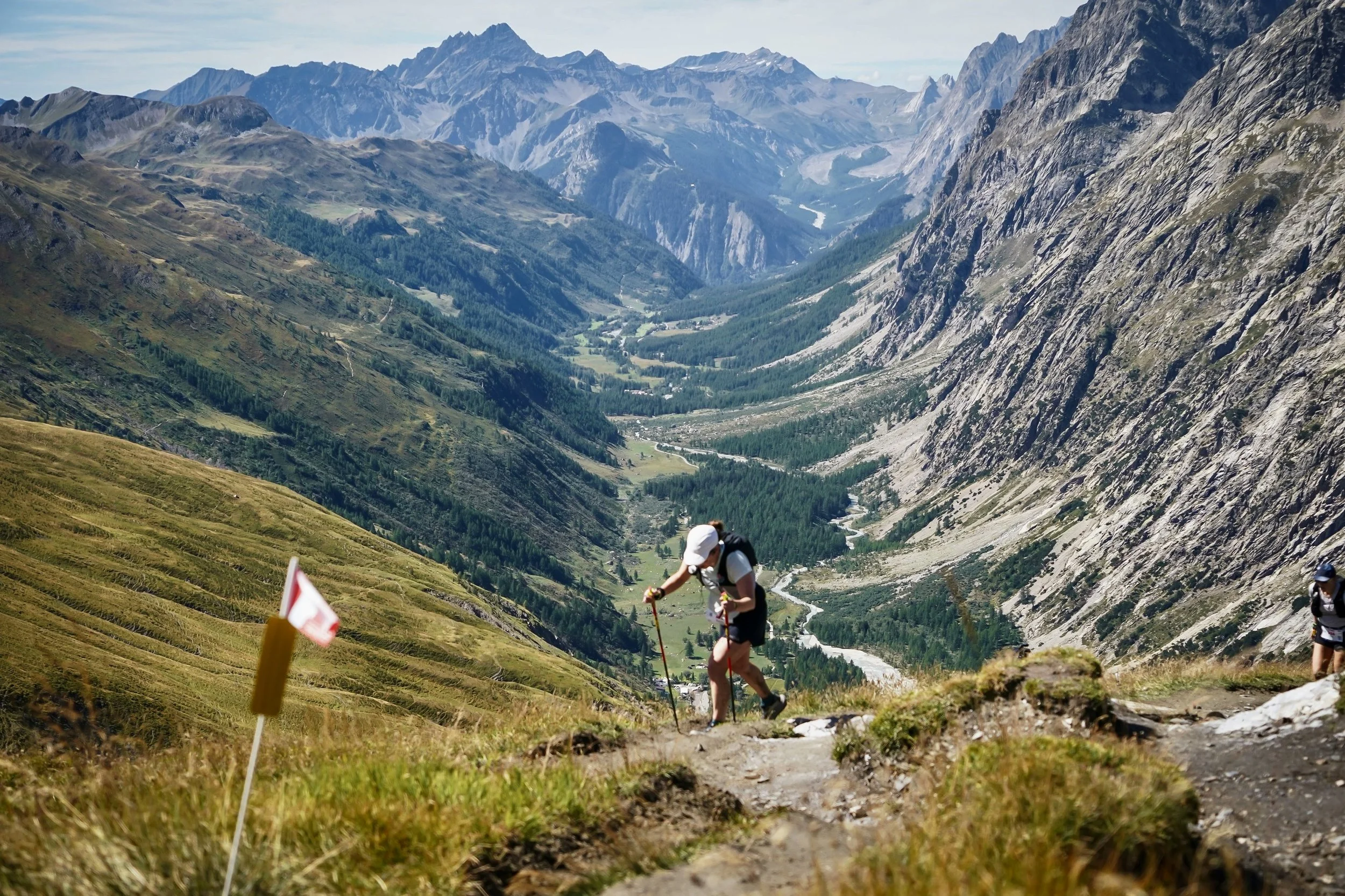
Climbing up the Grand Col Ferret, about 16.5 hours into the race.
The Other 27 Hours
What I’m not giving enough weight to are the other 27 hours—the hours where things actually were going well and where the race did feel representative of who I am as an athlete. I was flying through climbs and descents under the full moon, feeling strong, and crushing PRs on essentially every climb. For most of the race, my body was doing exactly what I had trained it to do. But because those five and a half hours went so badly, my brain wants to let them outweigh everything that came before and after.
Then there was Champex-Lac (mile 78). By the time I got there, I had fully convinced myself I was done. I had already changed into my warm clothes. I was ready to board the bus back to Chamonix and take what, in that moment, felt like the ride of shame. I wasn’t debating whether to continue. I had decided I was done. I genuinely thought my race was over. When I got there, I lay down and cried, took Zofran, smashed a ton of calories, and sat there staring into space for more than 30 minutes. Eventually, Reed started asking whether I could at least try running again. We went back and forth for a long time and finally decided I would probably regret it if I didn’t at least find out. So I reset everything and said I’d try running to Trient. No time goal, no finishing goal, no expectations. Just give it an honest shot.
As I headed back out into the night, Reed looked me directly in the eyes and said, “I’m so proud of you.” That moment meant so much more than continuing a race. A past version of me would have quit because I would have been too worried about what one bad result meant about me or my identity as an athlete. This time, I didn’t have anything left to prove. I just wanted to see what happened if I kept going.
One mile of running turned into several, and then somehow I was flying up and down the trails, beating my previous splits and feeling stronger and stronger. I found this incredible flow through the night where nothing mattered except moving forward. It felt so right and so completely like me. Over the final 30 miles, I took more than an hour off my time from that same section last year. I passed around 200 people. After being awake for two full nights, after spending hours completely bonked and emotionally wrecked, I somehow found my legs again and crushed the finish of that race. That happened too.
The five and a half hours where everything fell apart were real. They mattered. They cost me a lot of time and changed the race I thought I was going to have. I don’t need to minimize that to feel better about the outcome. But those hours don’t get to erase the other 27.
The climbs under the full moon happened. The PRs happened. Leaving Champex when I had already decided I was quitting happened. Passing 200 people happened. Finding a version of myself late in the race that I honestly didn’t know was still there happened. Taking more than an hour off my final 30 miles from last year happened. And finishing strongly after being awake for two nights happened.
There is so much about this race that I’m proud of, and there is also so much to mourn about the race I thought I was capable of having. I keep wanting one of those truths to win—to decide whether UTMB was ultimately “good” or “bad.”
Maybe neither one has to win.
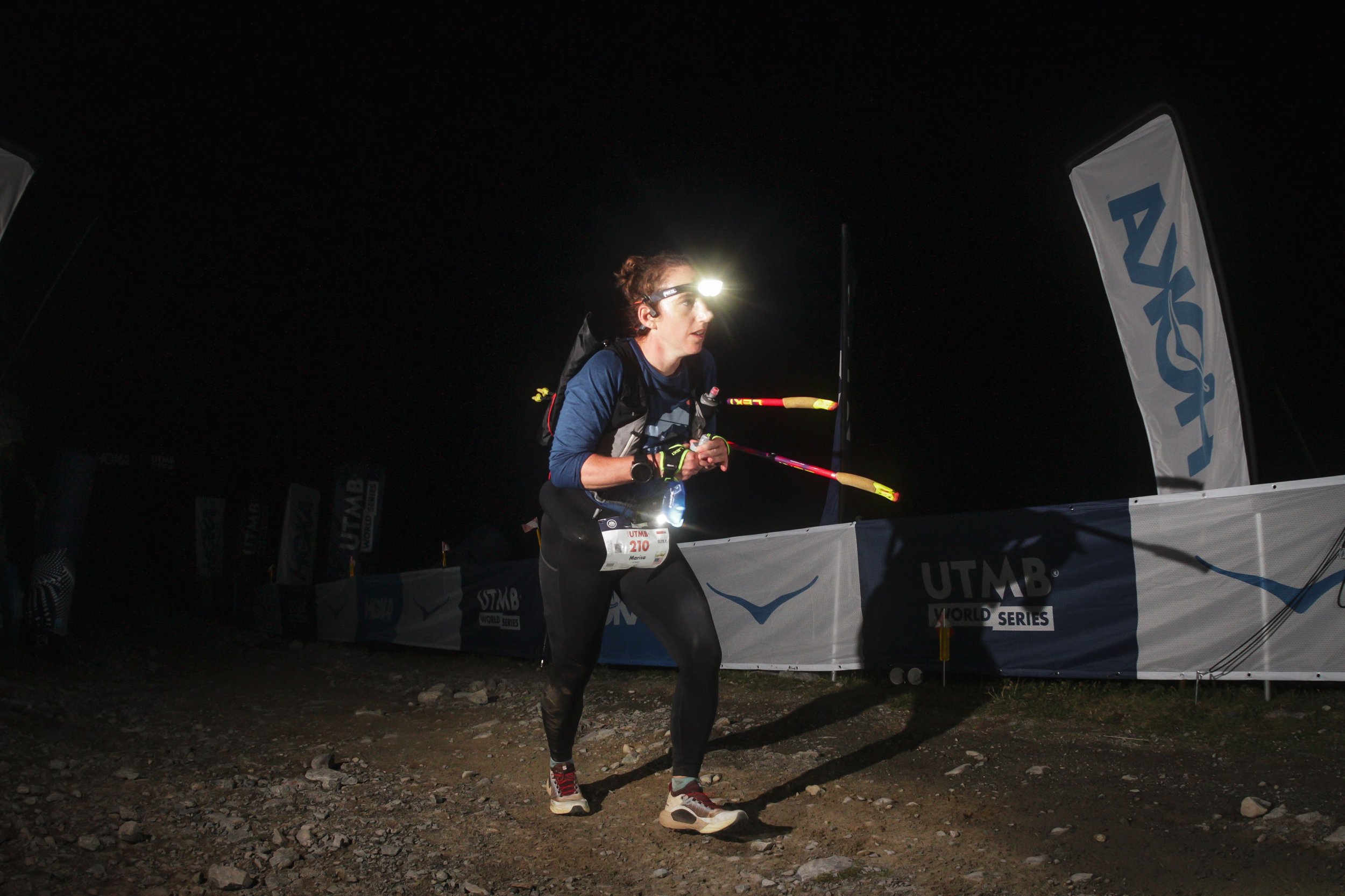
Climbing up to La Flagere in the wee hours of the morning.
Grieving a Race That Never Happened
I think a lot of this comes down to grief. As a high-achieving, Type A endurance athlete, somewhere deep inside me is the belief that if I work hard enough, I should get a corresponding result. Work in. Result out.
Before a race like UTMB, you almost have to create a story in your head about how the day could unfold. I have to believe I can hit my splits. I have to believe I can execute the plan. I have to believe I am capable of having the race I trained for, because without that belief it becomes very difficult to stand on the starting line of something this enormous.
So you create a possibility. A future. Almost a memory of something that hasn’t happened yet.
And when the day goes completely sideways, you grieve it. You mourn the loss of something you never actually possessed: a possibility, a dream, a version of yourself crossing the finish line after the day you thought you were going to have.
That grief is real even if the thing you lost never technically existed.
I should probably know this lesson by now. The trail has taught it to me plenty of times. The trail gives you nothing. You deserve nothing. The mountains don’t care how hard you trained or how much you sacrificed. You have to get an absurd number of things right to have an A-day in a 100-mile race—not just during the race, but throughout the days and months leading into it.
And that’s difficult for someone like me to accept. I want effort and outcomes to have a clean relationship. I want the result to prove the work. Sometimes it does. Sometimes it doesn’t. That doesn’t make the work less meaningful, and it doesn’t make the disappointment less real.
Both things can be true.
Maybe the Point Is the Grey
I think the only way to have true longevity in this sport is to fully embrace the process, which is something I know intellectually and am still learning emotionally. Ultimately, the 32 hours I spent racing UTMB made up maybe 1% of this entire training block. One percent. The other 99% was months of training, early mornings, long weekends, thousands of feet of climbing, time outside with people I love, and becoming a stronger athlete along the way.
It feels almost ridiculous to let such a tiny percentage determine how I feel about the whole thing. But at the same time, that 1% mattered a lot to me. It was the entire point of the training block. So when it doesn’t go the way you planned, and you cross the finish line knowing you had so much more to give, it’s really hard to swallow.
And this is another place where I have to resist making things black and white. Saying the process mattered doesn’t mean the result didn’t. I don’t have to convince myself that the race outcome was irrelevant just because the training was meaningful. It mattered to me. I wanted to see what I was capable of, and I didn’t get to see that this time. I can be disappointed by that while also knowing the months leading up to UTMB were still incredibly valuable.
The result can matter without being the only thing that matters.
Perspective is such a funny thing. In the moment, it’s so easy to get caught up in times, places, splits, and whether the race is living up to what you imagined it would be. But I kept thinking about how none of that is what I’m ultimately going to remember. I’m going to remember the connection with other people who share the same passion out on the trail. I’m going to remember the capacity of the people who love you to know you so well that they somehow say or do exactly the right thing in the hardest moments. And I’m going to remember realizing that you can always change the narrative in your own mind.
When I zoom out far enough, I also know this experience will probably give me more than the race I wanted would have. I’ll take it with me into future races, but also into the rest of my life. Maybe someday with my future kiddos. Definitely with my students. And especially in my work with athletes, because I’ll understand a little more deeply what it feels like to do everything you can, care enormously about something, and still not get the outcome you thought you had earned. There are lessons in this experience that I probably couldn’t have learned from another perfectly executed race.
Maybe one day I’ll tell my future kids about the time I spent hours crying my way through the Alps, decided I was quitting, changed my clothes, nearly got on a bus—and then somehow turned around and ran another 30 miles. And I know I’ll be proud that this is the version of the story I get to tell them.
At the end of the day, almost nobody cares about my finishing time the way I do. Rationally, I know that. The people who love me will still love me. I still have my job. I still have my friends and training partners. Nothing meaningful about my life changed because the number next to my name on a results page was four hours slower than I wanted it to be.
But knowing that my finishing time changes absolutely nothing about how the people I love see me doesn’t magically make me care less about it. Those are two different things.
The feelings of shame and inadequacy come from the expectations I place on myself and from how deeply I connect achievement with whether I’m living up to my potential. And I don’t necessarily want to get rid of that part of myself. Wanting to do my very best is part of who I am to my core. I love chasing my potential. I love working toward something difficult and seeing how good I can become. That drive has given me a lot, in sport and outside of it.
The goal probably isn’t to stop caring or convince myself that results don’t matter. Maybe it’s learning how to care deeply without allowing one outcome to become a judgment of who I am. To believe I’m capable of more without needing the current version of myself to be inadequate.
So I guess I’ll keep trying. And I’ll keep trying to sit with the nuance when things don’t fit cleanly into success or failure. The cool thing is, I’m not sure I’ll ever actually arrive. That’s probably what the pursuit of mastery is.
And I think that’s part of why we choose this completely ridiculous sport in the first place. We join a community of people who somehow normalize running 108 miles around the Alps through the night because, on the surface, we’re trying to master a craft. But I don’t think mastery is really a finish line. I think we pursue mastery of ourselves through mastery of something difficult enough to continually expose us to who we are—our strengths, our weaknesses, our egos, our fears, our expectations, and our ability to adapt. The craft is just the vehicle. For whatever reason, I’ve chosen ultrarunning. And underneath the miles, the mountains, the training blocks, and the results, I think what I’m really chasing is a deeper understanding of myself.
I’m starting to think this race was part of that pursuit too. It wasn’t the proof of what I’m capable of that I wanted, but maybe that’s exactly why it mattered. It forced me to sit with disappointment without letting it erase pride, to hold failure and growth in the same hand, and to understand that not every meaningful experience needs to fit neatly into one category.
What keeps bringing me back to these races isn’t the finish line, the time, or the result. It’s the feelings. The highs and lows, doubt and awe, suffering and gratitude, fear and connection, flow and pride. Those rare moments when everything gets quiet, and you feel completely alive.
I got to feel so much in those two days. Maybe that’s what these races give me more than anything: a ridiculously intense, condensed version of the human experience. You hurt. You doubt yourself. You laugh and cry. You need other people. You surprise yourself. You see things you’ll remember forever. And somehow, you come out the other side knowing yourself a little differently.
To me, that feels like the epitome of the human experience. I think that’s why I am so deeply in love with this sport.
So maybe the lesson from UTMB isn’t deciding whether the race was a success or a failure. Maybe it’s becoming someone who no longer needs it to be either—someone who can live in the grey, keep chasing mastery, and keep moving forward anyway.
